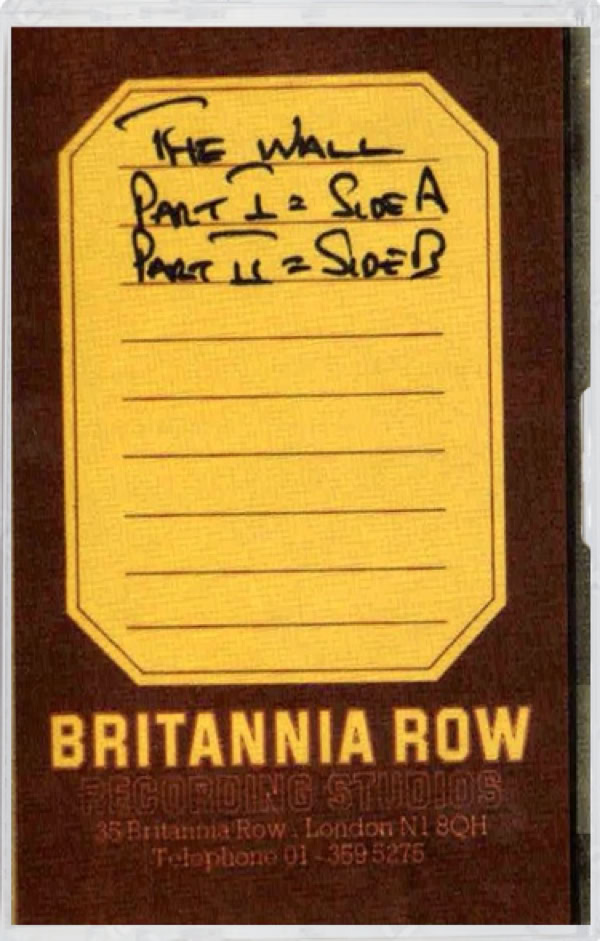
« Monsieur René Magritte Soundtrack » (Waters, Gilmour/1978)
Un ensemble de morceaux, on peut même parler de bribes instrumentales, très court provenant la plupart du temps de chutes (on peut parler ici de scories) des séances d’enregistrement de «Obscured by Clouds » et de «The Dark Side of the Moon» . On peut ainsi remarquer, parmi huit pièces de musique, une version de On the Run. Les autres parties viennent de l’oeuvre de Bartok.
Who’s sorry now ? (Waters/1978)
This track will be reworked to become The Show must go on later.
Instrumental interlude aka Prelude aka Vera (Prelude) (Waters/1978)
Present on the first demo presented to the band in September 1978 under the title We'll meet again, this is an atmospheric track based on excerpts from Vera Lynn's We'll meet again with a synthesizer sound mixed with wind noise and ending with a heartbeat.
Is there Anybody out there ? (part 2) (Waters/1978)
The song begins in the same mood the album version, except that the slide guitar in the intro disappears and is replaced by the synth and a bass pedal. The finale is slightly different with unreleased lyrics.
Is there anybody out there?
Is there anybody
Out there, on your own
Naked by the telephone
Casually leaning on the Wall
To stop you falling
Waiting for the call
Are they footsteps in the hall?
The knock on the door
Cannot stim the sensation
Of seemingly, endless freefall...
Is there Anybody out there ? (part 3) (Waters/1978)
Blues version of the song which was abandoned after some hesitation on the part of the album's three producers. Lyrics available here
Is there anybody out there ?
Is there anybody out there ?
Is there anybody out there ?
Is there anybody out there ?
It’s never too late (Waters/1977)
Previously unreleased finale to the « Bricks in The Wall » project developed by Waters.
The Thin Ice (part 2) (Waters/1977)
This instrumental coda was present on Waters' first demo and constituted the first 'finale' of the album « The Wall ». This composition was soon abandoned in view of the plethora of instrumental passages on the « Bricks in The Wall » project. It was a partial instrumental cover of The Thin Ice. Still present on the January 9, 1979 demo.
Overture for Comfortably Numb (uncredited/1979)
A long introduction to Comfortably Numb was worked on at the Producers Workshop on October 9, 1979, during a 14-hour session. Apart from this recording session, there are no other traces of this track, which obviously didn't end up in the final mix. It's true that the band had to shorten the third side of the album for reasons of space (especially Run like Hell). It's not impossible that the 33-second transition between Bring the boys back home and Comfortably Numb is an extract from this track. On April 1, 1992, during the "Concert for Walden woods" with Don Henley, it's not impossible that Roger brought out this track again. He played a 36-second, atmospheric introduction, in stark contrast to the original.
Death Disco (aka Death to the Disco) (Waters/1978)
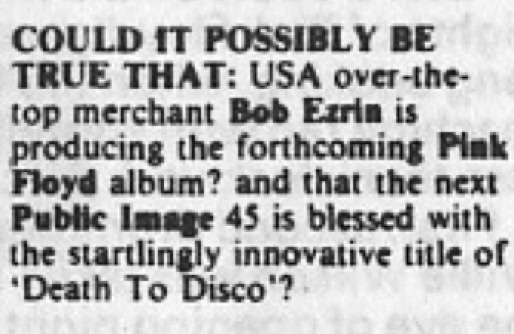
A track Waters developed in disco form. He resigned himself to withdrawing it from the « Brick in the Wall » project at the insistence of Bob Ezrin, who described it as "horrible". Certain verses were used in the song In the Flesh, and certain musical parts developed by Gilmour were reused in Young Lust. It's curious that this song should have appeared in the band's demos when Bob Ezrin, the record's co-producer, worked on exactly the same track with John Lydon's band, Public Image Limited. Indeed, an article in the May 26, 1979 issue of Sounds may have been the source of the confusion. In any case, rock critic Janet Huck would have heard it, and Tim Renwick recalls
Tim Renwick:
« A silly, hackneyed song … in which a DJ harangued the audience ».
«Up Against The Wall», Huck, Janet, February 1980
Teach (Waters/1977)
This pre-version of One of the Few was not kept for the «Bricks in the Wall» project, but ended up on «The Final Cut» LP (under the title One of the Few). This track remained on Waters' demo and was not developed by the rest of the band, as it focused on the teacher character (with the title Teacher, Teacher and the happiest days of our lives) and this narrative arc was removed from the album.
Roger Waters:
«It was a more in-depth look at a bit of story that was The Wall. “One Of The Few” particularly was some material left over from The Wall that pertained to the teacher character, so we understand that he was actually ex-RAF and had his own problems »
«Interview with Jim Ladd», Syndicated radio, 8 November 2000.
Sexual Revolution (Band Version) (Waters/1978)
A pre-version worked on by the band while working on Waters' two demo tapes in parallel. This track would become 4:41 - Sexual revolution on "The Pros & Cons of Hitch-hiking", Waters' first solo album in 1984. It held its own for a long time on the various demos of "The Wall" project, and was only removed from the one produced in March 1979, given that the theme of this track was close to that of Young Lust.
Interviewer: « (...) And Floyd never thought of recording Pros and Cons … ? »
David Gilmour: « The demo's for both The Wall and Pros and Cons were unlistenable, a shitty mess. The demo's for both sounded exactly alike, you couldn't tell them apart. I mean we thought of recording Pros and Cons at a later date, but as it turned out Roger preferred to go off and do it as a solo project. So we had to put a hell of a lot of work into that ».
«Interview with Brain Damage's Richard Ashtonand Glenn Povey», Brain Damage Fanzine. September 1987.
The Last few Bricks (Waters/1980)
This instrumental is not strictly a new song, but rather a medley of some of the tracks from the first side of « The Wall ». Since, it was released on the live album « Is there Anybody out there? The Wall live 1980-81 ». In order to respect the timing of the wall's construction during the show's performances, this song was added to give the roadies time to put in place the final elements of the structure for the first part's finale, Goodbye Cruel World.
It included The Happiest Days of Our Lives, Don't Leave Me Now, Young Lust, Empty Spaces, In the Flesh (slow motion). However, it wasn't set in stone, and the title evolved during the concerts. For example, the chord progression from Breathe was sometimes repeated. The longest version dates back to the first concert (February 7, 1980).
The roadies were totally late at the time, and the band improvised an instrumental for a good 6 minutes (close to the central break of the live version of Childhood's End in 1973). This brought The Last Few Bricks to over 13 minutes!
Roger Waters :
« In rehearsal, we discovered that physically the guys who were building the wall didn't have time to finish it for Goodbye Cruel World, so we had to fill in a few minutes of time. So we actually played a kind of reprise of tunes from the first half. There's nothing new about that either, it's just a medley of bits from the first half of the show »
« Interview with Roger Waters By Jim Ladd », SFX Radio, March 2000.
Overture (Waters/1981)
Unreleased (developed for the film, but left unreleased), written by Waters à la « Tommy ». Although Parker found the title very pretty, he decided to dispense with it, as the calm inherent in the piece didn't match the thunderous tone he wanted to set at the start of the film.
Alan Parker:
« Also there was a prelude, a quite remarkable piece of music which, unfortunately, didn't quite work with the rather unusual, quiet beginning of the film, and sadly had to be left out »
« Notes on Pink Floyd The Wall », American Cinematographer, October 1982.
Outside The Wall (Orchestral version) (Waters/1981)
The title was re-worked for the movie with an complete different instrumetation.
Roger Waters:
«We were contracted to make a soundtrack album but there really wasn’t enough new material in the movie to make a record that I thought was interesting. The project then became Spare Bricks, and was meant to include some of the film music, like When The Tigers Break Through and the much less ironic version of Outside The Wall which finishes the movie… plus some music written for the movie but left on the cutting room floor»
«Melody Maker», 1982.
« Instrumental » (Unknow/1981)
This instrumental is intended to bridge the gap between Is there anybody out there? and Nobody Home.
Tim Renwick:
« It was the short instrumental between Is There Anybody Out There? and Nobody Home. It is actually untitled and consists of classical guitar and orchestra. I recorded it at Abbey Road Studio 1; the orchestra was already on tape. Michael Kamen was producing and there were no members of the band present. I attended the premiere of the movie and was disappointed to note that I did not receive a credit! That’s life!! ».
« Interview w/. Tim Renwick », Gilmourish.com, May 2007.
In the Flesh ? (Geldof’s version) (Waters/1981)
Re-recorded version of the track with Bob Geldof on vocals. New synthesizer parts have been added and the intro is doubled.
Geldof, who would add Barrett's "Arnold Layne" to the Boomtown Rats' live repertoire, still balked at the notion of singing one of Roger's songs in The Wall. For a price, he finally did agree to record his own "In the Flesh" voice-over at musical director Gil-mour's twenty-four-track home studio (in the sixteenth-century
Henley manor house
Dave had bought from guitarist Alvin Lee and would later sell for £850,000). At first, Geldof mischievously brayed Pink's neo-Nazi manifesto in a heavy Irish accent, "like a drunken farmer at a Kerry agricultural show." The singer delighted in the "look of horror creeping over the faces" of Gilmour and engineer James Guthrie, but after tormenting them through several takes finally sang it properly. As soon as he had done so, Dave's voice resounded over the studio monitors: « You bastard » »
Cited in « A Saucerful o Secrets - A Pink Floyd Odyssey », Nicholas Schaffner, 1992
Mother (Film version) (Waters/1981)
Completely reworked version of the title track. The traditional instruments have been replaced by an orchestral version written by Michael Kamen. Waters and Gilmour re-recorded his vocals parts. Only solo guitars remained the same. This is an alternate line of the lyrics
What shall we do now ? (Roger Waters) in « Pink Floyd The Wall » (1982)
David Gilmour: Guitars, Hohner Clavinet D6, Prophet-5, Strings on ARP Solina; Roger Waters: Vocals, CS3, bass guitar; Rick Wright: Piano; James Guthrie: Strings on ARP Solina.
The song was put off the album for timing and pace reasons.
James Guthrie:
« For us, it was always on The Wall album until very late in the proceedings. But we removed it at the very last minute to make things a bit more concise »
Ice Magazine, January 2000
James Guthrie:
« We realized as we were mastering the thing that side two was just too long and we had to get rid of something. And 'Empty Spaces' and another cut that used to be on there called 'What Shall We Do Now' are the same tune. So 'Empty Spaces' was a reiteration, musically, of that tune towards that end of the side and so we just axed 'What Shall We Do Now', but we've left the lyrics on the back because they help tell the story »
« Interview with Jim Ladd », December 1979
Interviewer: « And then comes the track What shall we do now ? The assumption this would be when the emergent adult »
Roger Waters: «That’s right. Now that’s the track that’s not on the album. It was quite nice! In fact I think we’ll do it in the show. But it’s quite long, and this side was too long, and there was too much of it, it’s basically the same as Empty spaces and we’ve put Empty spaces where What shall we do now ? is »
Interviewer: «Because without those words listening to the album»
Roger Waters: «Yeah it makes less sense».
«Interview with Tomy Vance», Novembre 1979
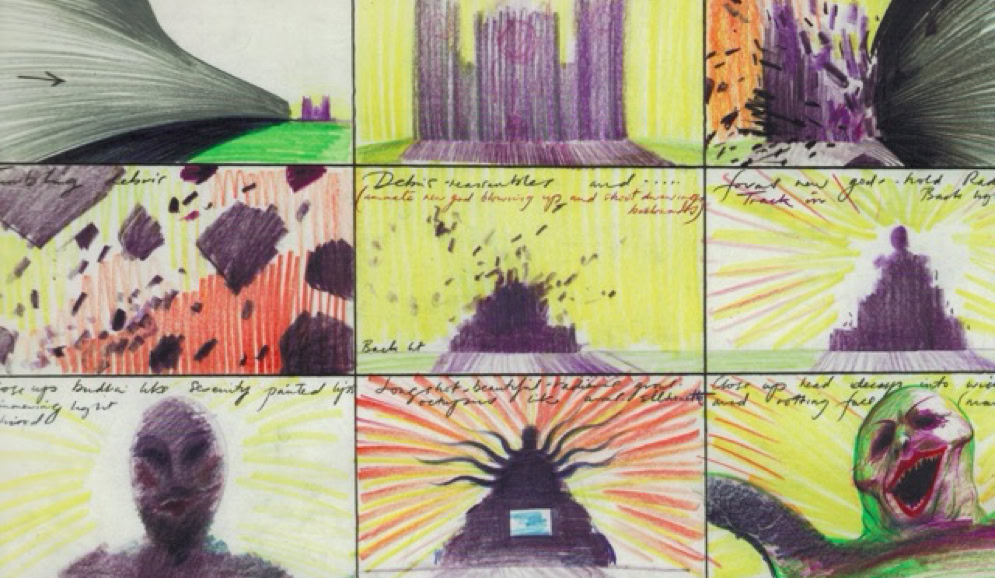
The original storyboard for What shall we do now ? sequence
The Hero’s Return (part II) (Waters/1983)
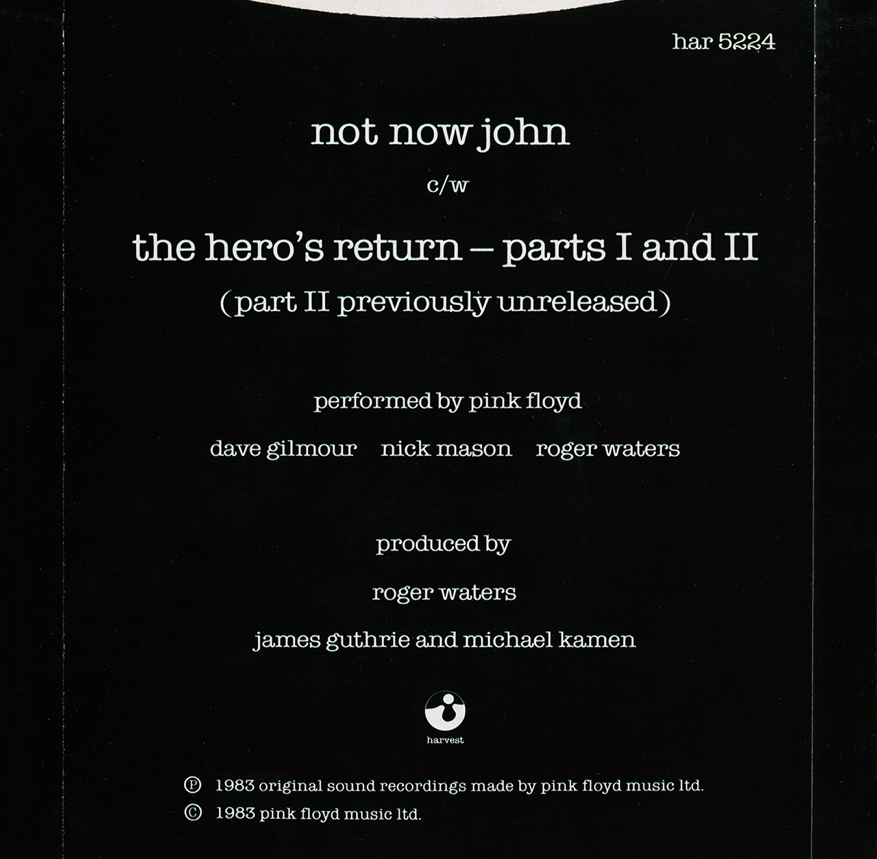
Not exactly an unreleased track, since it appears on the B-side of the Not now John single, alongside the first part. On the album, this was cut because the song was a little too long. It's also strange that this part was not included in the remastered version of the album (released in 2003) instead of When the Tigers broke Free, which is directly linked to "The Wall"!
Jesus, Jesus, what’s it all about?
Trying to clout these little ingrates into shape
When I was their age, all the lights went out
There was no time to whine and mope about
And even now, part of me flies
Over Dresden at angel's one five
Though they'll never fathom it behind my sarcasm
Desperate memories lie
Sweetheart, sweetheart, are you fast asleep? (Good)
'Cause that's the only time that I can really speak to you
And there is something that I've locked away
A memory that is too painful
To withstand the light of day
When we came back from the war
The banners and flags hung on everyone’s door
We danced and we sang in the street
And the church bells rang
You possible pasts (Waters/1978)
A pre-version of Your possible pasts, developed by Waters and featured on "The Final Cut" (1983). A few verses can be heard in the film "The Wall".